Need Adobe Reader?

Welcome to the home of the KRLA Beat

Something new has been added!

01.23.10 

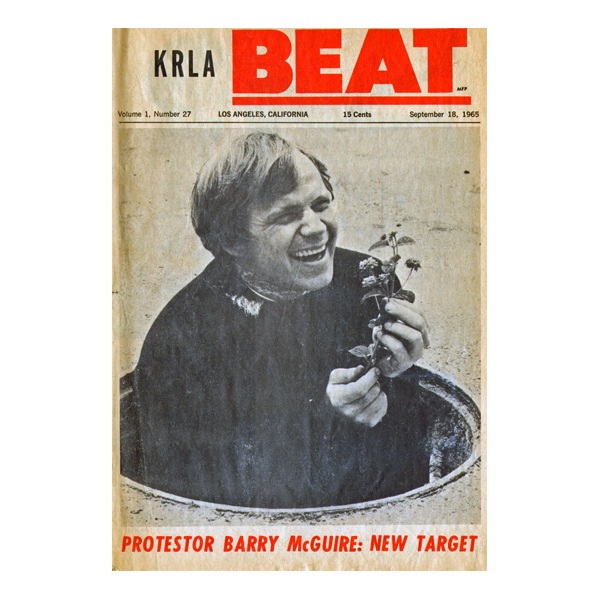
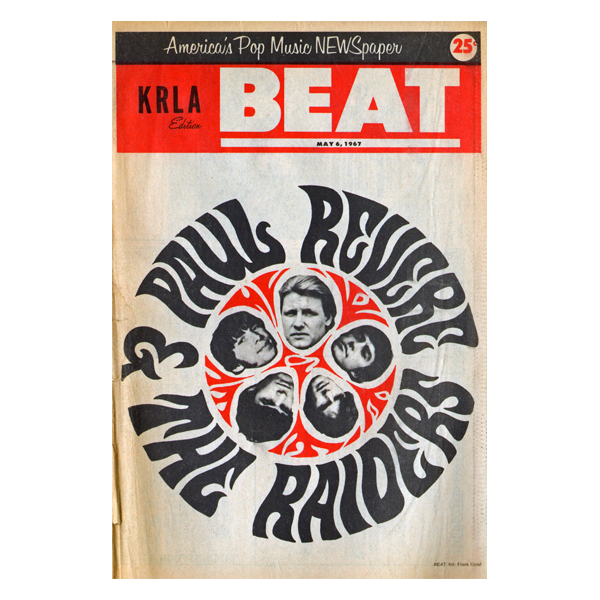
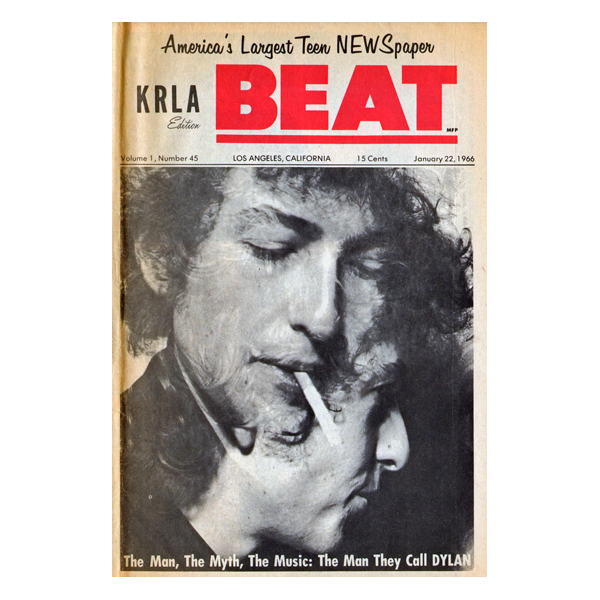
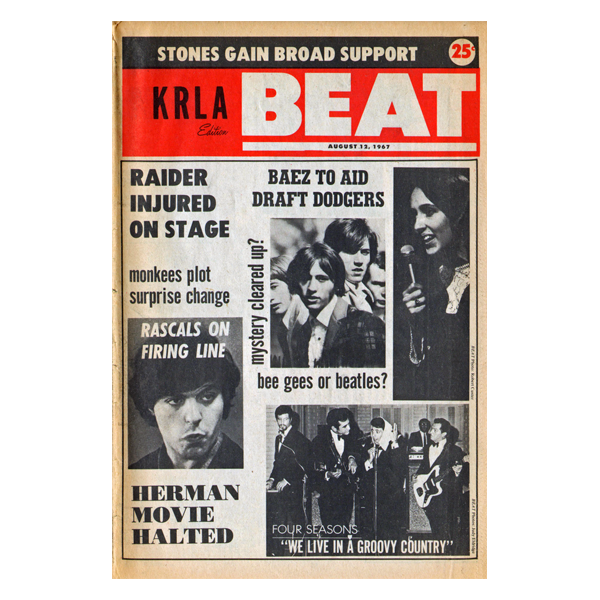
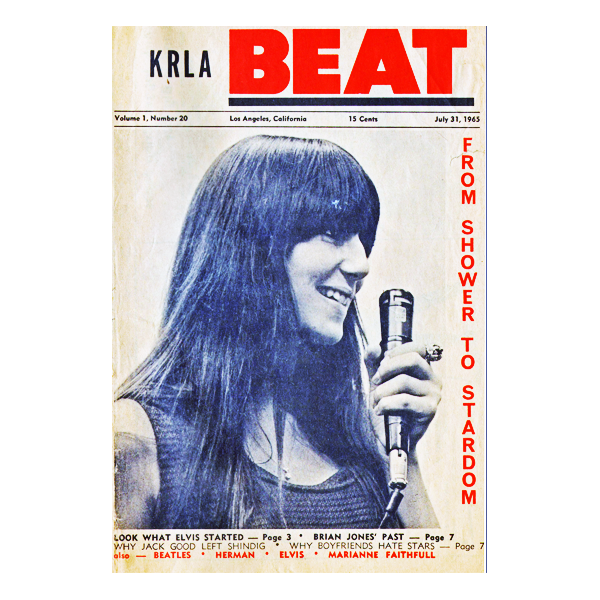
The KRLA Beat was the earliest American newspaper to cover the top-forty music scene. The Beat, published by Pasadena radio station KRLA 1110, grew from a small four-page newsletter in 1964 to a 16-page weekly (and later 24-page bimonthly) edition by 1966. During its four-year run The Beat was an invaluable source of information about the changing music scene of the 1960s.

The KRLA Beat featured exclusive interviews with singers, musicians, and producers as well as concert updates and record reviews. Columnists included Tony Barrow, the Beatles' publicist, and Derek Taylor, former assistant to Brian Epstein.

This online collection has been assembled from private resources and copies donated by generous people around the country. You can read the entire run of the newspaper, from February 25, 1965 to May 4, 1968. Also available are fifteen of the twenty known KRLA Beat newsletters issued to KRLA fans from October 1964 to February 1965.

To start, click on the Archive tab above, scroll down the page, and click on any image to open that particular issue in your PDF reader of choice. If you run into any problems, please contact the webmaster for assistance. Issues are listed in chronological order.

We're missing just five newsletter-style issues from the KRLA Beat's earliest era. If you own an issue not represented here and can provide a photocopy from your own collection for scanning, feel free to contact the webmaster. We'll be most grateful and will reimburse all expenses and postage.

More issues of the KRLA Beat have been added to the Archive this month. Scroll down to view what's new to the collection. If you have any additions, corrections, or comments, we'd love to hear from you!

February 22, 1965: Dueling deejays

01.22.10 

Both Reb Foster and Dave Hull had records on the charts, the Beat reported this week. Reb's was his own single, "Something You Got", produced by Sonny Bono (of Sonny & Cher fame). Both Cashbox and Billboard picked it as a "best bet", but it didn't see too much chart action.

Neither did Dave's record but it was a part of KRLA's playlist nevertheless. The Scuzzies' "Dave Hull, the Hullabalooer" was actually written and recorded by fifteen-year-old Suzie Capetta, her teenage brothers Robert and Michael, and cousins Gale and Paula Chodkowski. Dave's column refers to another article about it in the Beat but it must have been pulled for reasons of space. There was a lot of other news in this issue, that's for sure.

Some of the stories covered in this issue include Ray Davies' marriage, Charlie Watts' written tribute to Charlie Parker, a book called "Ode To A High Flying Bird", updates on the T.A.M.I. show and on the status of the H-1 visa debacle.

This was the final issue of the newsletter-style KRLA Beat. It's not clear whether the editor of this version, Bonnie Golden, was aware that another project was in the works. She wasn't part of the new editorial team that debuted just three days later when the KRLA Beat became an official newspaper with a new editor-in-chief, KRLA news director Cecil Tuck, and regular columns by former Beatles press officer Derek Taylor. In fact, Bonnie went on to a career in news and sports journalism under the name of Wina Sturgeon. As for the KRLA Beat, it was about to chart a new course. PDF size 3.51 MB.

February 5, 1965: Will they or won't they?

01.21.10 

This week's Beat published an alarming report about the suspension of H-1 visas, which would prevent most if not all non-American entertainers from performing the United States. Meanwhile American pop stars like the Righteous Brothers, Chuck Berry, and Del Shannon had no trouble obtaining travel documents to perform in England. The Beat included a second article on the topic on page three. This one sounded a lot more positive, citing "last minute flashes" that suggested the travel ban would be short-lived. Considering the number of British groups queued up for American concerts, that must have been a relief to readers at the time.

According to the New York Times the snafu originated in early January with the American Federation of Television and Radio Artists (AFTRA), which objected to the appearance of the British satirist David Frost on American TV on the grounds that he would be "taking a job from an American television performer." In reality, the H-1 vis problem would remain for a few more months. Several forthcoming editions of the KRLA Beat mention the story as a continuing annoyance to British Invasion groups who hoped to entertain American fans.

Meanwhile the Beat visits deejay Reb Foster's Revelaire Club in Redondo Beach. The idea of a KRLA deejay with his own nightclub wasn't new. Bob Eubanks had the Cinnamon Cinder in the San Fernando Valley and by 1966 Dave Hull would be host at the Hullabaloo Club on Sunset Boulevard. Check out the groovy Rebel Room! PDF size 3.11 MB.

January 21, 1965: KRLA looks for the roots of rock

01.20.10 

It was an ambitious project. This week's Beat reported that KRLA was developing a TV special to explore the roots of rock and roll, to be aired the following week on local station KCOP-13. Most of the basic musical contributors were covered, though Buddy Holly seems a conspicuous omission -- surely there was archival footage afloat -- and the influence of Motown seems to have been under-represented. But it was a start.

KRLA had a long-term interest in the history of rock and pop music. For the July 31, 1965 issue the KRLA Beat presented an article by singer Jerry Naylor, then touring with The Crickets, which mapped out the growth of rock and roll, complete with a handy chart showing its rhythm-n-blues and country-western ancestry. And from 1967 to 1969 KRLA's newsman John Gilliland researched and interviewed musicians for the "Pop Chronicles" radio documentary, which explored the development of popular music from the 1940s through the 1960s. Broadcast in 1969, the documentary ended up being 55 hours long. Gilliland's work was considered to be so ground-breaking that the original interview tapes are part of the John Gilliland Collection at the University of North Texas library.

In the photo gallery this week The Hullabaloos are featured, visiting the station and getting acquainted with Dave Hull's fan club. If you look carefully you'll see some details of the KRLA studios as they looked in the mid-1960s. By the way, today (January 20) is Dave Hull's birthday. Happy birthday, Dave! PDF size 2.6 MB.

January 14, 1965: British Invasion or Soul?

01.19.10 

Why not both? The Hullabaloos, mentioned in the previous week's issue, were "adopted" by KRLA's Hullabalooer Dave Hull, who probably sensed an opportunity. Although the British group's cover of Buddy Holly's "I'm Gonna Love You Too" reached number 56 on the American charts, the group had trouble establishing a strong identity in the presence of more popular British acts like The Searchers. The Hullabaloos performed on TV's "Hullabaloo" show several times but their brief brush with fame flickered out by the end of 1965.

Manfred Mann talked to the KRLA Beat about the resurgence of soul music in the pop charts, noting that "today's teenagers are a lot more hip than they were five years ago." Manfred mentioned the Rolling Stones' recent release "Time Is On My Side", clearly influenced by Irma Thomas' version.

The nice thing about reprinting photos from earlier Beats is that we often get more detailed captions! Finally the Beat tells us who deejay Bobby Dale was talking to: it was Al Jardine from the Beach Boys. A couple of KRLA's newsmen are featured in the gallery this week, including Richard Beebe (later part of the Credibility Gap) and news director Cecil Tuck at the microphone.

To our delight, starting with this week's Beat, the editorial crew finally added a publication date to the masthead. All issues from this point forward are easy to place in historical context. PDF size 2.7 MB.

January 7, 1965: The British are coming!

01.18.10 

Lots of English groups had plans to visit the Los Angeles area in early January 1965 for various TV or film appearances. The Beat's report appears to have been written in December 1964 but held over for publication in the new year.

Among expected visitors were The Hullabaloos (from Hull, hence the name), who were to appear on the "Ed Sullivan" variety show in late December. The Hullabaloos never did make it to the show but Ed was busy booking others, such as The Animals, The Dave Clark Five, Gerry and the Pacemakers, and Cilla Black, all of whom appeared on the show in the early months of 1965. The British Invasion was still going strong.

Photos for this week include a selection of pictures from past issues of the KRLA Beat. Notable is a rare look at the Beatles' August 1964 press conference at the Cinnamon Cinder nightclub, owned by deejay Bob Eubanks. PDF size 2.7 MB.

January 1, 1965: A new "Hullabaloo"

01.17.10 

The American network ABC had all its bases covered with two popular TV shows aimed at teenagers, "American Bandstand" (which had been running for years) and the newer "Shindig!", which presented British Invasion groups as well as American artists. Not to be outdone, NBC got into the act with "Hullabaloo", launched in January 1965. The show used a series of guest hosts, among them Brian Epstein, whom the Beat interviewed for this issue. The show was originally designed to feature English groups, particularly those not so well known in the U.S. KRLA's own Hullabalooer, deejay Dave Hull, had nothing to do with the show, in case you were wondering.

The photo gallery in this issue shows what all the fuss was about back in November 1964 at the Santa Claus Lane Parade in Hollywood. Deejay "Emperor" Bob Hudson rode in relative splendor in an antique car, while Dave Hull's "junky" float sailed down Hollywood Boulevard to the delight of KRLA fans along the route.

The Beat also shows us behind-the-scenes views of deejay Reb Foster's first recording session, which was produced by Sonny Bono of Sonny & Cher fame. Dropping by for moral support were Cecil and Gail Tuck. Cecil Tuck was a KRLA news reporter and was shortly to become publisher of the newly-revamped KRLA Beat, which went to a newspaper format in February 1965. PDF size 2.8 MB.

December 23, 1964: It was a very good year

01.16.10 

In this issue the KRLA Beat waxed nostalgic about 1964, the year Beatlemania hit America and everyone's lives changed. Certainly KRLA was riding higher than ever with burgeoning ratings and the knowledge that it was the undisputed official Beatles station in the Los Angeles radio market. One thing the The Beat failed to mention was that KRLA almost lost its broadcasting license in 1964...but what's a little bump in the road when you're on your way to the top?

The Beat noted that last year at this time only "one or two people had hopped on the Beatle bandwagon." How soon they forget! KRLA was actually one of the few stations in the U.S. to play a Beatles song in mid-1963, "From Me To You," which reached number 32 on the KRLA Tunedex in July 1963.

As a special holiday treat for KRLA Beat readers, Herman's Hermits and the Rolling Stones provided autographs for fans to enjoy. Don't forget to check out the vintage Vox guitar and amp ad on page 3, "the greatest name in sound." PDF size 2.6 MB.

December 9, 1964: Dave Hull vs. Santa

01.15.10 

In the eyes of KRLA Beat reporters, Dave Hull was the star of Santa's own parade! The Hollywood Santa Claus Lane Parade was a tradition going back into the 1940s. In 1964 KRLA entered a float and Dave Hull asked his listeners to send in anything they wanted to decorate it. Doors, tire tractors, and street signs were just a few items offered by loyal listeners. Someone even brought a litter of kittens to the station -- all of which were given away to good homes rather than used as float decor.

In the photo gallery this week the Beat offered some pictures from the T.A.M.I. Show held in Santa Monica the previous month. Jan and Dean emceed the show, and other performers included the Rolling Stones, Gerry and the Pacemakers, the Supremes, Leslie Gore, Chuck Berry. Although KRLA didn't sponsor the show, they were nevertheless a backstage presence. You might spot a photo of KRLA Beat editor Bonnie Golden (later known as Wina Sturgeon) sorting through photos with Gerry Marsden and Billy J. Kramer.

This week's "Contest Corner" prize: Tommy Quickly's very own shirt. One hopes it was laundered first. PDF size 2.6 MB.

December 2, 1964: Stones collapse

01.14.10 

All work and no play makes Keith a dull boy...Brian too! Both were ill, the Beat reported, and on two weeks' bed rest. As a cautionary gesture their manager, Andrew Oldham, had Mick, Charlie, and Bill checked out, and cancelled all pending performances.

The news wasn't all grim. Tommy Quickly's brief foray through the Land of Eleven Ten was noted, particularly his special press conference set up just for fans at KRLA deejay Bob Eubanks' nightclub, the Cinnamon Cinder. Everyone thought that Tommy and his manager Brian Epstein were "so nice".

This issue's photo gallery shows scenes from the Dave Clark Five Long Beach concert held the previous week, including support groups like the Standells, the Vibrants (a house band at the Cinnamon Cinder), Joey Paige, and Round Robin.

Deejay Reb Foster was the force behind the "Fax On Wax" column. He referred to the upcoming new Beatles LP scheduled for release on December 4, which had sold a half-million copies before its release. This was "Beatles For Sale", at this point available only in England on Parlophone. Americans would have to make do with "Beatles '65", released a week later on Capitol with only some of the "Beatles For Sale" tracks included. By the way...can anyone verify whether Paul McCartney was really playing piano on the Peter & Gordon hit "I Don't Want To See You Again"? It would make sense, since McCartney wrote it for the duo. PDF size 2.6 MB.

November 18, 1964: KRLA welcomes the DC5

01.13.10 

1964 proved to be a banner year for KRLA, which sponsored the Beatles at the Hollywood Bowl, the Rolling Stones, and now the Dave Clark Five. The DC5 had easily sold out their November 25, 1964 concert at Long Beach months before they came to the States and were also contemplating movie plans with Warner Bros. studios.

But KRLA wasn't ignoring the Fabs. Their new single, "I Feel Fine/She's A Woman", would be released nationally on November 27, but the Beat notes that KRLA had already been playing the song, scooping every other radio station in the country.

This issue's photo gallery highlights the recent Los Angeles appearance of the Rolling Stones, who shared the bill with Jimmy Clanton, Dick and DeeDee, and the Soul Brothers.

It wouldn't be the KRLA Beat without a contest. This week readers were invited to guess what the call letters of the station mean. The winner would have a dinner date with Fabian...who, in late 1964, probably had a lot of time on his hands. PDF size 2.6 MB.

August 27, 1966: It was the worst of times....

01.12.10 

Maybe this was the wrong time for the KRLA Beat to go to a twice-monthly format. In this issue they play catch-up with one of the biggest Beatles news stories of the decade.

John Lennon's remarks on Christianity were first published in London and New York to general reader indifference, but when a brief excerpt was republished in the American teen magazine "Datebook" in July 1966, a fierce maelstrom resulted.

The Beat covered Brian Epstein's fears of possible riots during the upcoming Beatles tour and reporter Maureen Cleave, whose original interview was the source of the "Datebook" story, tried to explain what John had really meant. Not exactly helpfully, Paul McCartney commented that he found Americans' pursuit of money "sort of frightening" and George Harrison noted that the Beatles were coming to the States "to get beaten up."

It was a chaotic musical world for others as well. The Animals lost two veteran members, Hilton Valentine and Chas Chandler; The Hollies let go their bass guitarist Eric Haydock; there was plenty of fallout from a dust-up in Phoenix, Arizona between Dave Clark and local deejay Dick Gray; and Time Magazine decided to declare pop music "obscene".

Of course there was plenty of other news in this 24-page issue. Louise Criscione reviewed Johnny Rivers' career, and the Beat declared The Kinks to be "modern rebels" of rock (a little premature at this point, perhaps). The Beat also wondered whether Dylan was "weird" and reviewed the rise of folk singer Odetta, a San Francisco phenomenon. Mike Tuck, brother of Beat publisher and editor-in-chief Cecil Tuck, penned an article on Terry Slater, a British bassist for the Everly Brothers who were on tour in England at the time. Mike Tuck would later go on to pursue broadcast journalism in the Los Angeles area.

This week's Beat also noted the hiring of comedian and satirist Stan Freberg, who had made a successful career for himself in advertising and comedic records. Freberg's stint as consultant to KRLA was his first such role, though it's worth recalling that Freberg had worked for the station over twenty years before when it was known as KPAS-1110. In 1945 Freberg voiced commercials and character impersonations for the Harmony Homestead radio show every morning at 9:45. KRLA had come a long way since then! PDF size is 18.4 MB.

Oct. 28, 1964: "This boy electrified me"

01.11.10 

So said Brian Epstein about his latest discovery, Tommy Quickley (also spelled Quickly, born Thomas Quigley). With characteristic hyperbole, Brian assured the KRLA Beat that Quickley "will be the biggest star in the world", even bigger than the Beatles.

Despite Epstein's support and a debut song penned by Lennon/McCartney called "Tip Of My Tongue", Quickley failed to catch on anywhere, either in the USA or in England, and retired from the music business in 1965.

The middle pages are devoted to the recent KRLA-sponsored concert which included a mix of British and American stars, such as Gerry & the Pacemakers, Billy J. Kramer & the Dakotas, and Sonny & Cher (Cher wore a dress for her performance).

A production note in the interest of legibility: while these early issues were printed as four-pagers, these scans include an extra image to capture the center of the Beat's two-page photo spread, so that captions and pictures aren't cut in two.

This issue's date is estimated from a brief article about The Ronettes, who performed on "Sunday Night at the London Palladium" on October 11, 1964, and the chart listing for The Supremes' "Baby Love", which first went to number one in the week of October 31, 1964. None of the early Beat issues carry masthead dates, though they do sometimes refer to the date of the next scheduled issue.

An earlier October 1964 issue (possibly October 21) precedes this one, with the headline "Kinks In Auto Crash, Taken To Hospital". If you own it and would like to share a photocopy of it, please contact us. We'll cover all expenses and will happily credit your generosity if you wish. PDF size is 2.85 MB.

April 7, 1965: For fans of George Harrison

01.10.10 

The second part of a four-part interview with each of the Beatles is featured in this week's issue. Derek Taylor's unique insider status paved the way once again for KRLA to get close up to one of the Fabs.

George talked a bit about the filming of their second movie, the plot of which was still a bit of a mystery to him: "I'll wait until they finish making the film and then I'll go and see it and then I'll know what's happening," he offered to KRLA deejay Dave Hull.

Derek Taylor's regular column discusses Freddie & the Dreamers, a band that had only recently found success in the USA, as well as the Righteous Brothers and pianist Johnny Pearson, who had just released a cover of Vince Guaraldi's "Cast Your Fate To The Wind".

This week's Beat also covers the Supremes, Marvin Gaye, and Joey Paige, who was spending time with his friends the Rolling Stones in London. PDF size is 2.9 MB.

Want to help?

By the end of January 2010 this online resource will include all known newsprint issues of the KRLA Beat, plus most of the four-page newsletters issued by KRLA from October 1964 through February 1965. Questions? Want to add something to the webpage? Have an aircheck you'd like to share? Please contact the webmaster.