KRLA and the Beat history
KRLA personalities
KRLA specialties
KRLA Airchecks
Dick Biondi, KRLA debut 1963
Dick Biondi had three successful years as the top deejay at WLS 890 until 1963, when despite his close friendship with the WLS administration he decided to take a two-month hiatus from his on-air position. Billboard reported that he was being pressured to increase his commercial breaks from 12 per hour to 18, not to mention hosting teen dances without prior clearance to see whether his schedule permitted.
Rumors abounded. It was suggested that Biondi was going to prominent New York area stations...but he didn't. He ended up at KRLA in Pasadena. You can read the story here in Billboard.
Remarkably an aircheck has emerged, recorded by an associate, and you can hear the first tentative fifty minutes of Biondi's first evening at the station. He was clearly terrified. He mentioned several times what it was like to run afoul of his boss at WLS. He mangled his station identification. He forgot to use the time buzzer to accompany the time announcements. Poor lad! He exhorted his listeners to smile and be happy.
It's rare enough to hear a major deejay sound so uncertain, but it's a lovely view of the first moments where Biondi was establishing his own persona on the Los Angeles airwaves. There are also some rare jingles, a nice news reading by Richard Beebe, a Sie Holliday sequence, and some cracking songs from the playlist at the time. Thanks to Rewound Radio, Timmy Manocheo, and Bruce Dumes for this wonderful historical artifact.
Dick Biondi debut, KRLA July 1, 1963
Bob Eubanks and Dick Moreland, April 19 1964
This is a particularly nice aircheck because it's from early in 1964 (Sunday, April 19, 1964 to be exact) and it's unscoped, meaning you can hear each song played in its entirety. You also get the thrill of hearing Bob Eubanks sign off his Sunday afternoon show and Dick Moreland come on for his own 6:00-10:00pm weekend airtime.
This aircheck starts with a snippet of Dave Hull, then heads into the Bob Eubanks show. Included are two news breaks by KRLA newsman Carl Mesmer, later a KABC TV news reporter. In the meantime you'll hear advertisements voiced by Dave Hull, a "Hudson's Commandos" satirical spot, numerous weather reports (it was cold and rainy that evening), and a plethora of top thirty hits of the day. In fact, Bob Eubanks had just finished playing all the top thirty tunes that afternoon on his show.
The Beatles held the number one and two positions on the Tunedex that week so it's no surprise that you'll hear a lot of Fabs singles during this hour. In fact you'll even hear one of the fabled Beatles double plays, back-to-back hits. So profound was the British influence on programming that Dick Moreland announced one station I.D. dryly as "This is KRLA, sometimes known as the BBC annex."
I've seen this aircheck attributed to the collections of both Gordon Skene and Javed Jafri, so it's unclear what the correct provenance may have been. What's clear, though, is that the date has been misattributed. It's not April 18, 1964, as reported elsewhere (that was a Saturday), but rather April 19, 1964. Moreland clearly identified the broadcast as a Sunday evening one.
Bob Eubanks and Dick Moreland, KRLA April 19, 1964
Jingles package 1961-1965
Jingles, jingles, jingles...it's how a radio station brands itself. You've heard KRLA jingles before (we have a nifty fifteen minutes' worth below) but here's a real treat for your ears.
Douglas C. Brown, KRLA Production Director from 1981-85 and again in 1992, has shared this high-fidelity collection with us. We're very grateful!
These professionally produced drop-ins represent the typical sounds of the station, and most date from 1961 (dig that crazy jazz rhythm!) through 1965, when KRLA upgraded its jingle package with tunes based on the T-Bones' first and ephemeral hit, "That's Where It's At." Good luck finding a copy of that record. They seemed to have all disappeared in November 1965.
This selection is available for streaming only rather than download, but play to your heart's content.
High-fidelity jingles package
A classic sound: Jimmy O'Neill, October 1961
Jimmy O'Neill, all of nineteen years old, was the first announcer heard on KRLA when it changed its call sign from KXLA and format to top-40 in September 1959. This excellent hour-long unscoped aircheck (courtesy of Gordon Skene) reveals a confident, professional voice as he works his way through the Tunedex of the week.
O'Neill, a native of Enid, Oklahoma, had actually begun his radio career at the age of seventeen at stations such as KGWA in Enid and WKY in Oklahoma City. He had aspirations beyond AM radio, however. He eventually left KRLA to become the host of TV's pop music show "Shindig" in 1964. He spent some time on other Los Angeles radio stations such as KFWB and KDAY before venturing to stations in New Mexico and Nebraska in the 1970s only to return to KRLA for periodic gigs in the 1980s.
Those who paid attention to the Los Angeles club scene may also remember Jimmy as the owner of Pandora's Box, a popular nightclub at the corner of Sunset Blvd. and Crescent Heights in West Hollywood.
This week's show in 1961 included a song by almost-forgotten Texas singer Gene Thomas, called "Sometimes" (listen for it about thirty minutes into the broadcast). You'll also hear Jim Steck, KRLA newsman, handle a couple of new breaks, and commercials for local establishments that should sound familiar to those who listened to KRLA in those days. Want to follow along in the Tunedex? Bob Harlow has kindly shared a copy of the printed version for your reading (and listening) pleasure, click here to read it.
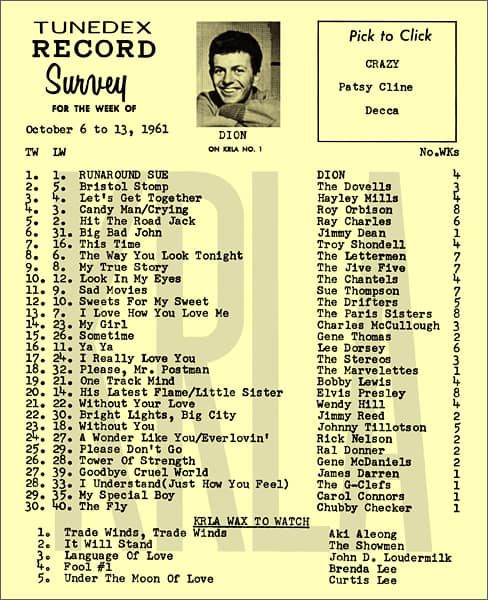
Note: there's some tape "wow" at the beginning of this aircheck but it settles down later in the program.
Jimmy O'Neill October 1961
Beatles for sale: Dave Hull, July 1964
Dave Hull, known as The Hullabalooer, joined KRLA in 1963 but found his "voice" once the Beatles hit America. He had a night shift from 9pm - 12am in 1964, though he occasionally filled in for others earlier in the evening, which seems to be the case in this excerpt. Tonight's show included a "Beatles Bonanza" with extra Beatles tunes throughout the evening. "I'll Cry Instead" had just been added into rotation.
Portrait painter Nicholas Volpe, who had done promotional paintings for album covers and advertising, had just completed oil portraits of the individual Beatles in 1964 and Dave offered listeners the unprecedented chance to buy four reproductions for fifty cents each "now available at your favorite supermarket, beautifully displayed in cellophane packs". The originals cost a lot more now.
KRLA deejay Dick Moreland portrays the fictitious "Ed Reemus" with Bob Eubanks as his sidekick for a Downey Ford commercial. For the benefit of those who might not have heard, Dave proudly proclaims KRLA the number-one station in Los Angeles, a position previously enjoyed by rival station KFWB.
Dave Hull July 1964
A jingle-jangle morning, 1961-1966
Most of these jingles were developed circa 1961 and represent the "classic" KRLA themes, using a nice brass section and harmonizing choral group. Radio stations were defined by their sound and once entering the top-forty arena they needed a recognizable presence.
About six minutes into the collection you'll hear some of the "new" theme music from late 1965, which was based on the melody of the 1964 T-Bones release "That's Where It's At", a precursor to their big hit "No Matter What Shape (Your Stomach's In)."
KRLA bought up the rights to "That's Where It's At" and developed a whole new collection of intros, outros, and KRLA musical IDs. If you were a fan of KRLA during its all-request days, these are the jingles you'd remember best.
Jingles were required for nearly every on-air event. At the top of the hour you needed a catchy song for station identification. The news required its own intro, as did the weather, traffic reports, sports, on-air games, and special promotional shows. Included were a set of nifty sound effects, like teletype noises, excitable city noises for "man-on-the-street" documentary productions, and alarmist trumpet fanfares for breaking news that were guaranteed to catch your attention.
Jingles 1961-1966
Around the clock with KRLA, October 1961
This pastiche of airchecks from several different sources follows KRLA's line-up in late 1961. Bob Eubanks was a young deejay hired from KACY in Oxnard, California to fill the midnight to 6am shift, where he began to develop his warm, upbeat on-air delivery.
You'll hear show intros and outros for morning man Wink Martindale from 6am to 9am; Roy Elwell from 9am to 12 noon; Dick Moreland (another hire from KACY) from 12 noon to 3pm; afternoon drive personality Jimmy O'Neill from 3pm to 6pm, Sam Riddle from 6pm to 9pm, and Frosty Harris from 9pm till midnight.
This month also brough Wink Martindale's farewell from KRLA when he accepted a promotional position at Dot Records. Buried in Martindale's emotional farewell is a subtle reference to unspecified rumors about the station. KRLA had recently been accused of rigging on-air contests and falsifying its station logs, which would eventually result in the FCC pulling KRLA's license in 1963. If you're an amateur radio enthusiast you'll catch a bit of morse code toward the end of the Martindale farewell -- that would have resulted in another kind of license trouble at the time.
You'll also hear a snippet of Bob Eubanks in his new morning drive slot, replacing Martindale, and an excerpt of one of Los Angeles' few women deejays, Sie Holiday, giving the time check into Roy Elwell's 9am show.
Various Deejays October 1961
Stan Freberg at KRLA, 1966
For the first time ever, satirist and advertising wizard Stan Freberg threw caution to the wind and agreed to serve as a consultant to KRLA's self-promotion campaign. He was hired by the station in mid-August 1966, according to the August 27, 1966 issue of the KRLA Beat.
Station manager John Barrett told the Beat "Our approach has always been tongue-in-cheek. We recognize that the audience is listening for one thing...fun!" Of course there was that little thing called music too.
KRLA's ratings had begun to slip by this time, giving in to the inevitable wave of "more music more music" at rival station KHJ. Freberg's spots were meant to lighten KRLA's playlist and provide some of the same imaginative comic interludes that KRLA had been self-producing for several years.
Freberg had focused on musical satire in the 1950s and 1960s but he was also an award-winning producer of novel advertising campaigns for companies as varied as General Motors, the Orange Julius hamburger chain, the Chung King food company, the Mars candy manufacturer, Prince brand macaroni, and the United Presbyterian Church. When the Beat asked Freberg where KRLA would fit into this pantheon of advertisers, Freberg replied "Somewhere between Orange Julius and the United Presbyterian Church."
If you're not familiar with Stan Freberg's work for KRLA, you'll enjoy diving in for the first time...and tell us if you think that Dave Hull plays a small role in these bits. Come on in, the water's fine!
Thanks to Douglas C. Brown, KRLA Production Director from 1981-85 and again in 1992, for sharing these Stan Freberg promos. This selection is available for streaming only rather than download, but play to your heart's content.
Stan Freberg at KRLA
The wild Eye-tralian himself, July 1965
For sheer nuttiness it's possible that Dick Biondi may have had the edge over Dave Hull. This scoped aircheck from June 13, 1965 shows Biondi at his peak, mocking commercials, talking to himself, making funny noises in and around hit songs. The self-proclaimed "world's ugliest and skinniest" couldn't sing much either, which didn't put a stop to his on-air verbosity, luckily for his fans.
Call-in contestant Susan Georgino plays (and misses out winning) the KRLA promotional "DJ Horse Race" game, Bob Hudson performs a promo for the Casey Kasem show, Jim Steck drops in with a teaser about the news, and Dick introduces a non-single non-hit by the Byrds called "I Knew I'd Want You."
There was a method to his madness. The KRLA Beat's contributing editor, Derek Taylor, had left his gig as assistant to the Beatles' manager Brian Epstein and was promoting pop groups in Los Angeles, one of which was The Byrds. As a result, KRLA listeners were likely to hear more Byrds tracks than listeners of other local stations. That's a feature, not a bug!
Dick Biondi 1965
Mellow afternoons: Casey Kasem, October 1963
Casey Kasem had been at KRLA just five months when this aircheck was made, having made his way from San Francisco's KEWB. Kasem's approach to announcing was less frenetic than his on-air colleagues. He offered biographical information about each artist played during his early afternoon show and used teaser questions to keep his audience hooked from commercial to commercial.
At this point he had not yet added in his countdown of top ten records, a feature that he would debut on KRLA a short time later.
In this segment Karen Tommassio calls in to play "Record Roulette" (with only six dollars in the jackpot). The news is read by Cecil Tuck, later publisher of the KRLA Beat, Sie Holiday handles the timecheck into Kasem's second hour, and a variety of advertisements are offered for your pleasure, among them the newest sensation in beer cans, the "lift tab cans" from Falstaff.
Casey Kasem 1963
"Isn't that just a groover?": Dick Moreland, March 1962
Please forgive the fidelity of this clip and enjoy five minutes of Dick Moreland's memorable style. KRLA airchecks don't usually surivive from this era but this one was clearly recorded with reverence.
Dick Moreland was on the air from noon to 3pm at this stage, a shift later occupied by Casey Kasem, and we can date this clip to Saturday March 17, 1962 thanks to the playlist with Shelley Fabares' "Johnny Angel" at number one on the KRLA Tunedex, plus numerous references to St. Patrick's Day with Dick "O'Moreland" and newsman Jim "O'Steck". Moreland worked in references to fellow deejays Jim Washburne and Sam Riddle ("Be Kind To Sam Riddle Day," whatever that was meant to be).
Moreland mentions the House of Sight and Sound, a huge music and entertainment store in Van Nuys, which had just begun advertising on rock-and-roll stations. Their claim to fame involved checking in with deejays across Southern California to see what records were climbing the charts and building their record library on what kids really wanted to hear.
Dick Moreland was a steady presence at KRLA from 1961 to 1969, morphing into a program, music, or special promotions director as needed. He's fondly remembered by everyone who worked with him.
Dick Moreland 1962
"You mean we're on the air?": Dave Hull, May 1965
Dave Hull is nice and loose in this aircheck, which dovetails nicely with the beginnings of the KRLA Beat. The newspaper was just three months into its official newsprint edition. Several of the Beatles interview segments played by Dave on this show come from his recent trip to the Bahamas, which he reported in a recent Beat article.
Dave and KRLA Beat editor Derek Taylor had flown down to meet the Beatles on the set of their new movie, which would eventually be titled "Help!". Dave interviewed the Beatles extensively and played bits and pieces of their taped interchange on his show.
As the KRLA Beat reported, Dave also came away with a few previously unreleased Beatles songs ("Clarabella" was one of them) that the Beatles had recorded for their BBC radio show. Nice to have Derek Taylor as a compatriot. He had special privileges with the Fabs, and it was helpful to KRLA programming.
Paul's comment "Not nice, Dave" was actually in response to Dave's admission that he'd revealed the Beatles' parents' home addresses on his radio show...not nice at all. And George's comment ("I think I enjoyed the scene in the bathroom") referred to the filming of "Help!" which had not yet been released in cinemas. Dave used it to segue into a soap commercial!
Dave Hull May 1965
Dave Hull...fired? Reb Foster tells us why, May 1967
Ever since the Beatles conquered America, KRLA had gone out of its way to give Beatles fans what they wanted. That was the key to staying the number-one radio station in the Los Angeles market. Whenever a new Beatles release was i mminent, that usually meant that listeners would be treated to a KRLA sneak preview of the record or album. It's part of what kept KRLA listeners coming back for more.
But the release of "Sgt. Pepper's Lonely Heart's Club Band" was different. Despite what had been done in the past, this time Management refused to allow Dave Hull to premiere any part of the new LP (whose music Dave already had on tape) until its official June 1, 1967 release date. Dave felt this was disloyal to his listenership and tried desperately to argue his point to KRLA's upper echelon, to no avail.
So on April 29, 1967, Dave skipped his scheduled shift at KRLA in protest. On May 1, station manager John Barrett announced with regret that Dave Hull was fired from KRLA.
In this aircheck from that day, Reb Foster sounded bewildered and off-balance as he told listeners what had happened. He noted his support for Dave, despite the fear that KRLA management wouldn't appreciate such sentiments. In fact, according to Bill Earl's Dream House, within a day KRLA deejays were prohibited from referring to Hull's departure on the air. Management's decision didn't sit too well with KRLA fans. Sit-ins and protests at KRLA's carriage-house quarters were polite but vocal. The crowds of Hull fans at 1401 South Oak Knoll eventually made their mark. By the end of the week, Hull was rehired, and station life returned to somewhat-normal.
Reb Foster May 1967
Beautiful Bob makes a salad, September 1965
Bob Hudson, another hire from KEWB, started with KRLA in March 1963. His on-air persona evolved over the years from the egoism of "Beautiful Bob" to full-fledged royalty in the form of Emperor Hudson, whose show was punctuated by promotional spots such as the one that begins this aircheck (sharp-eared KRLA fans will recognize the voices of fellow deejays Casey Kasem and Dave Hull, as well a newsman Richard Beebe).
Hudson's approach was popular with morning listenership but he was clearly not always in touch with music trends of the era, evidenced by his disdain for Barry McGuire's then red-hot hit record "Eve of Destruction".
Compare this approach with the KRLA Beat, which at that time couldn't give enough newsprint to McGuire, his lyrics, and his musical philosophy...as well as John Barrett's valiant insistance on not banning the record when other Los Angeles radio stations were doing just that.
This short clip ends with an improvised recipe for salad, inspired by an advertisement for Wesson Oil.
Bob Hudson September 1965
"Thirty five days till B-day!" Casey Kasem, July 1964
If it hadn't been for the Beatles, KRLA might not have made it through 1964. Their licensing troubles still loomed large. While their right to broadcast wasn't terminated as the FCC had threatened, the station was operating on an interim license and was managed by a non-profit organization until the FCC could determine what course to pursue.
Meanwhile the FCC was accepting applications from entities wishing to replace L.A.'s number one Beatles station -- the station, no less, whose deejay Bob Eubanks had mortgaged his home to pay the Beatles' way to the Hollywood Bowl.
Don Page, who wrote about the radio industry for the Los Angeles Times, was barely able to contain his glee over KRLA's imminent demise. "Despite the bleatings of the Beatles and their adoring teen-age public" he crowed, "the purveyors of rock 'n' roll radio are diminishing." Soon only KFWB would be left, "a convalescence home for elderly teen-agers, or a museum of noise."
In this midst of this impending catastrophe Casey Kasem reigned cooly supreme. The only heat in this show was tempered by Coppertone sunscreen. A hunger for deliverance from the FCC jaws of doom was assuaged by Jack-in-the-Box onion rings. There were only 35 days left till the Beatles came to the Hollywood Bowl. Focus on this indelible goal. All else is commentary.
The mention of the Beatles concert date allows us to calculate this selection's air date as July 19, 1964. Enjoy!
Casey Kasem July 1964
"High and tight on the top": Ted Quillin, August 1963
In early 1963 Ted Quillin came to KRLA via KFWB to fill in the 9am to noon slot. With teenagers in school during that time listenership tended toward a more adult audience. Quillin's "Coffee Break" club, with rewards for cardholding listeners, its supermarket report, and its demographically mature advertisements were geared toward the grown-ups at home. The playlist too was more bluesy than teen-beat.
In this excellent-quality aircheck, fellow deejay Bob Hudson guests on a Mark C. Bloome spot. You'll also hear a promo for ex-WLS Chicago deejay Dick Biondi, the so-called "Wild Eyetralian". Apparently attempting to placate the FCC with its devotion to community service, Quillin's show offers a plethora of public service announcements, and Jere Laird, one of KRLA's newsmen, pops up periodically to keep the listening audience informed about late-breaking stories.
Ted Quillin August 1963
Like a heat wave: Dave Hull, October 1965
Toward the end of October 1965 Los Angeles experienced one of the most unrelenting heat waves ever recorded in the region, with ten consecutive days of 100-plus degrees in the valleys. A likely date for this aircheck probably falls toward the beginning of that period, either October 20 or 21 based on the temperature checks, the playlist, and the advertisements. If anyone has a confirmed date for The Turtles' concert appearance at the Skate-O-Rama in Downey in October 1965, that would help pin down the exact day of this broadcast...but I'm not expecting any miracles.
The recording quality is a tad muffled but Dave's characteristic ebullience is easy to hear. KRLA was still playing Beatles songs back-to-back ("a Dave Hull Beatles twin thingy") but there are also offerings from Nino Temple and April Stevens ("I Love How You Love Me," backed by the legendary Guilloteens with bagpipes!), "Mystic Eyes" by Them, and Bob Dylan's "Positively 4th Street." This clip highlights a passel of new KRLA jingles based on the "That's Where It's At" theme, and Dave even uses the original T-Bones song to close out his show.
Dave Hull October 1965
"Radio Los Angeles": KRLA news, September 1965
This short snippet focuses on KRLA news reporters Cecil Tuck and Jim Steck. For an AM top-forty format KRLA emphasized its news department strongly, employing a multi-reporter staff and scheduling news reports on the hour and half hour through most of the 1960s. Here Jim Steck reports on the crisis in Santo Domingo, Dominican Republic, allowing us to date this excerpt to September 1965.
In 1964 KRLA won two prestigious Golden Mike awards for best radio documentary and a special Golden Mike created to honor the station's historical series on the American revolution. In 1966 KRLA news director Lew Irwin won two more Golden Mikes for KRLA documentaries on drugs and "suggestive lyrics of today's music". In June 1968 Irwin, along with newsmen Richard Beebe, John Gilliland, Thom Beck, and folk singer Len Chandler created The Credibility Gap, a satirical show that followed the news and offered up to 15 minutes of political commentary. Nothing else like it existed on AM airwaves at the time.
KRLA Newsmen September 1965
"Blues for breakfast": Ted Quillin, January 1964
Audio quality of this aircheck is a little tinny but it's a nice slice of T.Q.'s on-air down-home style. The food-obsessed Quillin spends most of this snippet rhapsodizing about southern cooking ("When's the last time you had some real fresh sowbelly?"), candy bars, and market produce punctuated by his distinctive bluesy playlist. Obscure tracks by the Bill Black Combo, Booker T and the MGs, and The Impressions lend spice to this morning's music, accompanied by popular chart hits of the day by the likes of Bobby Vee, The Caravelles, and the Supremes.
Near as we can tell based on highlighted record releases and the mention of the film "The V.I.P.s" citywide release, this aircheck dates from Monday January 6, 1964 -- at least the first portion of it. Sharp-eared folks will note that after two-thirds of the broadcast the time checks are not sequential. The provenance of this aircheck isn't known but the level of trebly distortion is the same in both sections, so I'm betting that two recorded sections were either combined out of sequence or were recorded on subsequent days.
Ted Quillin January 1964
"You request 'em, the Hullabalooer plays 'em!" Dave Hull, August 19, 1966
It's hard to pinpoint when Dave Hull was at the top of his game. His popularity at the station certainly spanned the two years since the Beatles had been chart-toppers and successfully transitioned into KRLA's all-request format -- guess whose songs were requested the most?
KRLA also sports its new jingle package which had been revamped in late 1965. The melody was based on the little-known single "That's Where It's At" by The T-Bones, whose bigger hit was "No Matter What Shape".
In this excerpt you'll hear bits and pieces of the station's all-request playlist, which generally followed top forty chart listings in major trade publications like Billboard and Cash Box. A complete newscast is a special treat, as is a tongue-in-cheek Valhalla Thunderbolt Gasoline ad with the fictitious "Remington Noble" extolling its superior propellants.
This aircheck is elsewhere dated as June 18, 1966, but two of the news stories (the first photographs from the Lunar Orbiter and a car crash involving football players Roman Gabriel and Marlin McKeever) suggest that a more accurate date would be August 19, 1966. The promo about "nine days to get your Beatle tickets" for the August 28 show at Dodger Stadium was a bit of a giveaway as well.
Dave Hull August 19, 1966
"Pick up on the vibes": Jimmy Rabbitt, February 1970
As Eddie Payne, the deejay more widely known as Jimmy Rabbitt began his on-air career in Tyler, Texas in the fall of 1961. His career expanded with the British Invasion and he landed a lucrative position in Dallas at KLIF-AM.
By 1970 Jimmy Rabbitt was working the 9 pm to 12am shift at KRLA, relying on standard hits of the day as well as album tracks from rock classics such as the Beatles, Badfinger, Creedence Clearwater Revival, Thunderclap Newman, Jimi Hendrix, and Simon & Garfunkel. Advertisers had drifted into attempts at counterculture references (the Datsun commercial is a prime example) but most spots are as banal as they were in the early sixties.
Of particular interest to Credibility Gap fans, this night's broadcast provides a six-minute bit by the pared-down satirical group (Harry Shearer, Richard Beebe, David L. Lander and Michael McKean) who, in the guise of the Three Stooges, invade Richard Nixon's oval office and almost start World War Three. The entire news program was nearly twelve minutes long. You can catch the Credibility Gap starting at the 13:30 mark in this 36-minute-long aircheck.
Broadcast on Saturday night February 27, 1970, this aircheck also reveals that KRLA had gone back to its original jingle from the early 1960s, a rather incongruous reminder of the past.
Jimmy Rabbit February 1970
"Big time with Casey": Casey Kasem, June 1964
A nice KRLA trumpet ID and a promo for "Hudson's Commandos" opens this short excerpt from Casey Kasem's afternoon show. The air date for this show isn't exact, but Casey's mention of Dick Clark's latest "Caravan of Stars" is a bit of a help.
The June 13, 1964 issue Billboard Magazine listed the same lineup for this traveling show mentioned by Casey, among them headliner Fabian plus Mike Clifford, Terry Stafford, and a Los Angeles based singer called Round Robin. The show was set to debut later that month on June 26, so this narrows down the time frame of this aircheck.
One of the Beatles' compatriots, Billy J. Kramer, was enjoying a number one hit in Los Angeles, though mainstream music was still a part of the pop landscape on KRLA. Case in point: Dean Martin's hitbound "Everybody Loves Somebody Sometime" and the Ray Charles Singers' "Love Me With All Your Heart" were also part of Casey's playlist.
As a teaser, Casey refers to two singers with five years of hits who still made time for college, one as an industrial design major, the other a medical student. They were Jan & Dean, in case you were wondering.
Casey Kasem June 1964
"Expand your consciousness, do your thing!" Bob Dayton, January 1968
KRLA launched its final Valentine Art Festival this month in an effort to connect with its more creative listeners. Winners of the contest would be highlighted in the KRLA Beat the following month.
Bob Dayton, one of KRLA's weekend and fill-in deejays, hosts this show on Sunday afternoon, January 21, 1968. Upcoming events, as Dayton notes, were Blair High School's Battle of the Bands and a concert by the Bee Gees (who had not yet gone disco) at the Anaheim Convention Center. Dayton thoughtfully gave his listenership the Bee Gees' incoming flight number in case someone wanted to meet them at the airport that afternoon.
This aircheck includes a nice advertisement for Wallach's Music City, then one of the biggest independently owned record stores in the Los Angeles area. Their flagship store was at Sunset and Vine but there were regional shops around Southern California. In this spot owner Clyde Wallach suggests that "there’s nothing better than listening to good stereo music on these long winter nights” and introduces a record trade-in policy for records you don't listen to anymore: one dollar per record. Wallach's didn't sell used records but it was a clever way to get young folks into the store and boost customer traffic.
Bob Dayton January 21, 1968
"Murray One Six Nine Nine One": Bob Eubanks, November 1964
Anyone who remembers that phone number probably listened to years of KRLA on-air promotions. This short-but-sweet clip highlights Bob Eubanks, sporting a surprisingly folksy delivery, taking a call for the station's "Music Man" game. Ken Weiner of Hi Point Street in Los Angeles wins it, to Bob's apparent relief.
Dick Moreland is the game's announcer and Sie Holiday recites the list of deejays. The little-heard Bobby Dale was KRLA's midnight-to-6am announcer, coincidentally the same on-air shift occupied by Eubanks when he was new to the station. By this time Eubanks was firmly ensconced in the much more desirable 6pm - 9pm time slot.
This clip dates from November 1964, based on the prize of two tickets to see the Dave Clark Five (and a host of other British and American pop music stars) in Long Beach on November 21. The KRLA Beat, still in its infancy at this point, showcased the concert in its November 18, 1964 issue.
Bob Eubanks November 1964
The spring festival of hits with Johnny Hayes, April 1967
In 1967, when Johnny Hayes called KRLA "L.A.'s king-sized vibrator", it didn't mean what you think it means. Airwaves, people, airwaves. The air date for this excerpt is Friday April 14, 1967.
This 31-minute aircheck includes a full five-minute newscast by KRLA Beat publisher Cecil Tuck. A wearer of many hats, he was still a newsman at heart and served as an on-air announcer when needed. Jim Steck provides the sports news. These were the days when a top-forty radio station could still suport a full investigative team.
Check out the advertisement for Radio Free Oz about 17 minutes into this aircheck. This show was hosted by a foursome of comics and political commentators known as the Firesign Theatre. They were shortly to perform their first live stage appearance at UCLA's Experimental Arts Festival but had just signed on with KRLA to broadcast from The Magic Mushroom club on Ventura Blvd. in the San Fernando Valley. "Easy radio for troubled times" indeed!
And for KRLA Beat fans, catch the ad for the Beat at about 22 minutes in. The cover issue for this week highlighted Bobby Jameson, a local songwriter whom the Beat tried valiantly to promote, with little success.
Johnny Hayes April 22, 1967
"Swing and be happy!" Dick Biondi's New Year's Eve, December 1965
"Music and cash time" transformed into celebrity call-in-time on New Year's Eve, Friday evening December 31, 1965. Dick Biondi fields phone calls from Gene Pitney, Bobby Rydell, Chubby Checker, Dion, Pat Boone, Casey Kasem, Tony Bennett, Neil Sedaka, and promises phone messages later that evening from Dave Clark and the Beatles in London.
News announcer John Land (later known as John Gilliland) is on hand to advise on the falling temperatures and crowds gathering in Pasadena for the Rose Parade the next morning and the Rose Bowl football game later that day. KRLA's studio was located just south of Colorado Blvd. on Oak Knoll Ave., so they were close to all the excitement.
Call-ins would also include KRLA deejays, who were probably grateful that they weren't saddled with an on-the-air shift that night. Casey Kasem couldn't quite remember the name of Herman's Hermits new hit but he did recall that it was written by "two very talented local boys, Phil Sloan and Steve Barri". The former was P.F Sloan, who had also written "Eve of Destruction". The song, by the way, was "She's A Must To Avoid", another in a string of hits for Peter Noone and his compatriots.
Dick Biondi December 31, 1965
"A two-toot salute": New Year's Day with Dave Hull, January 1966
Like a bookend to Dick Biondi's show the previous night, this aircheck features Dave Hull as he works his regular afternoon shift on Saturday January 1, 1966, playing the hits of 1965.
I count at least six mentions of the UCLA football team's unexpected triumph over heavily-favored University of Michigan. Both teams played the Rose Bowl in Pasadena that day and the game ended just before Dave's last hour on the air. It was the UCLA team's first-ever Bowl win.
Charlie O'Donnell, one of KRLA's regular deejays, reads an advertisement for the KRLA Beat's January 8th issue, with five full pages of Rolling Stones coverage. But get your subscription request postmarked by midnight -- only three dollars per year. What a bargain!
A brief clip of the news ends this selection. Dave's shift ended at 6:00pm. Next up would be Dick Biondi.
Dave Hull January 1, 1966
Surrealistic Sundays: Three from Derek Taylor, 1967
During Fall 1967 every week on Sundays at 8:30pm you could hear a half hour of one of the most eclectic radio shows on AM radio.
Former Beatles personal assistant and sometimes-reporter for the KRLA Beat, Derek Taylor, was offered radio space on KRLA, and he filled the airwaves with his own brand of surrealism and social commentary, peppered liberally with music that meant something to him and, he hoped, to his listeners.
This offering served as a warm-up for the equally adventurous airing of Radio Free Oz just following Derek's show, with the Firesign Theatre performing live radio skits from The Magic Mushroom club in Studio City. Sunday nights could be trippy at KRLA.
Three of Derek's shows are offered here for your listening pleasure.
In the first aircheck from September 17, 1967, Derek offers a selection of popular artists covering Beatles tunes at the time, reads an excerpt of a British press interview with George Harrison ("The songs write themselves," explains George when asked how Beatles tunes are born). Derek drifts into a discussion about George Formby, the British music hall performer who influenced thousands of musicians in England, the Beatles among them. After a brief political commentary about conservative radio commentator George Puttnam, actor Bob Hope, and televangelist Billy Graham, Derek ends with The Byrds' "Eight Miles High." Who knows? Someone in the studio may have been!
The second aircheck on October 29, 1967 includes a discussion about publishing rights, which must have been on Derek's as well as the Beatles' collective minds. Derek has an affection for comparative pop music, and a regular part of his show involved playing multiple versions of the same song by a variety of artists. Here the song is "I Wanna Be Free" by The Monkees, and Derek managed to round up covers by Trini Lopez, Bobby Boyce & Tommy Hart (who wrote it), pianist Floyd Cramer, crooner Andy Williams, the Golden Gate Strings, Jimmy Rodgers, and finally The Monkees themselves. Derek also reads a bit of Tony Barrow's column in the KRLA Beat and ends with folk singer Phil Ochs' rendition of "The Flower Lady."
In the third aircheck broadcast on November 5, 1967, you'll hear Derek reminisce about the Beatles' first official release on Parlophone happening five years earlier that week, but for purists, he was misremembering. This was November 5, and "Love Me Do" was actually released on October 5, 1962. In a nostalgic mood, Derek plays a few of the Beatles' earlier works by way of celebration. Derek mentions Paul McCartney's foray into movie scoring on the film "The Family Way." After a bluesy interlude with Tampa Red and the Rolling Stones, Derek plays "Flowers in the Rain" by a group then mostly unknown to American audiences, The Move, calling it "record of the year," followed by Elvis Presley's "Hound Dog." "This show is hastily assembled," offers Derek almost apologetically. His comparison this week: the Lovin' Spoonful's "Daydream" and Ian Whitcomb's retro rendition of "Got a Date With An Angel." The show ends with a fake advertisement for Mel de Mer Condominiums "where you live better aquatically" and a plug for Radio Free Oz, next on the evening schedule.
Derek Taylor September 17, 1967Derek Taylor October 29, 1967
Derek Taylor November 5, 1967
KRLA Reunion: Emperor Bob Hudson, October 1981
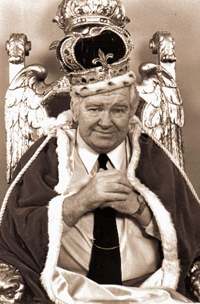
KRLA came up with a novel publicity stunt in 1981: why not bring a few original deejays back for a two day on-air reunion? It was the inauguration of a format readjustment too, emphasizing the personalities and playlists of the station's golden era. The event certainly captured the attention of KRLA's original listenership. Some of the "Porch People" even showed up at the station to hang out.
The line-up for Saturday October 31: Bob Hudson from 6-9am, Johnny Hayes (who had never left KRLA since he was hired in 1965) from 9-noon, Casey Kasem for an hour from noon to 1pm, Ted Quillin from 1pm to 3pm, Dave Hull from 3-6pm, Humble Harve (not an original KRLA deejay but hired long-term with Dave Hull for the new "heart and soul of rock and roll" format) from 6-9pm, and Bobby "Boris" Pickett of "Monster Mash" fame from 9-midnight for a Halloween special.
On Sunday November 1, KRLA scheduled Charlie O'Donnell from 9am to noon, Dick Moreland from noon to 3pm, Reb Foster from 3-6pm, Bob Eubanks from 6-9pm, and Dick Biondi from 9pm to midnight. At various points KRLA historian Bill Earl can be heard with commentary about KRLA's heyday. Original KRLA newsman Richard Beebe returned to read the news all weekend long.
Bob Hudson, accompanied by several of the original engineers from days of yore, appears to be having a fabulous time. He brought his bag of voice-over drop-ins to spice up his irrepressible royal patter and there are recruiting announcements for Hudson's Commados just like in the old days. Modern-day 1981 commercials for businesses that aren't there anymore are a little jarring, but at this point I guess they have nostalgia value too.
These tapes seem to have survived the decades with little degradation. The airchecks are fully unscoped, with music galore. They're also long. Each selection is a little over an hour and a half. The second half of these shows may turn up, and if they do I'll add them to the link. Or maybe an hour-and-a-half is enough for most listeners!
Bob Hudson October 31, 1981
KRLA Reunion: Casey Kasem, October 1981
For a fellow with so much broadcasting experience -- over twenty years -- at first Casey sounds absolutely petrified to be back at KRLA, live and on the air. He'd graduated to syndicated radio shows and TV appearances since leaving the station twelve years earlier. Now he was in front of the mike again, in real time, without the comfort of the editing room to take out any unintended mistakes.
He needn't have worried. Kasem had only an hour to spend at the KRLA reunion but he used it well, peppering his songs with biographical background just like in the old days. After a few minutes he began to warm up to the process again, though he admitted to having had dreams about being back at KRLA and running out of records to play.
Deejay Jim Diamond noticed a few indications of nerves from Kasem. "Casey pulled some grand boo-boos on the air during his one hour stint on KRLA," Diamond notes. "He got on what he thought was the two-way 'squawk box' to Rudy at the transmitter. Instead, right in the middle of Richard Beebe's news, you heard Casey say on the air right over Richard: 'Jesus Christ! You haven't changed a bit, man!' He also somehow broke the time tone -- Dave Hull later mentioned that later that day."
Kasem spent much of the hour reminicing about bands he used to host at local dances, including the Righteous Brothers, Caesar and Cleo (later Sonny and Cher), Eddie Haddad and The Band Without A Name, and Jan Berry of Jan and Dean, who once played (by himself) an entire set for Kasem when the headlining group didn't show up.
Casey also gives a few minutes to his one recorded claim-to-fame, "A Letter From Elaina," a soppy but sincere paean to one girl's experience with Beatlemania. Newsman Richard Beebe provided the headlines at the end of the show.
Casey Kasem October 31, 1981
KRLA Reunion: Ted Quillin
Following Casey Kasem's one-hour stint, Ted Quillin began the one-o'clock hour of the KRLA reunion. Quillin had been working the airwaves in Las Vegas but seemed delighted to accept KRLA's invitation to re-create his sound of yore.
Johnny Hayes (the only one of the Eleven-Ten Men who had worked at the station straight through since 1965) announced Quillin's return. Like most of the deejays that weekend, Quillin sounds overjoyed to be back at the helm, however briefly, and played a handful of tunes popular from KRLA's 1964-1966 playlist. This aircheck is a half-hour excerpt from his full two-hour show.
Alas, Ted is no longer with us, having passed away in April 2011, but Wikipedia has a nice overview of his career.
Ted Quillin October 31, 1981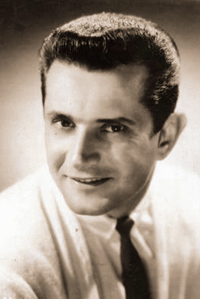
KRLA Reunion: Dave Hull
Since leaving KRLA in the late 1960s, Dave Hull had bounced around Southern California airwaves, but still he found it easy to step right back into his Hullabalooer costume -- literally. He even claimed to be wearing a shirt from 1965.
Dave appeared to have kept all his original props, horns, and bells and happily demonstrated their distinctive sounds to the radio audience. It was a hot weekend with brush fires in the local foothills, and newsman Richard Beebe used the old KRLA "breakthrough" jingle to alert listeners to the situation. And the Porch People were back to help everyone celebrate.
Unlike the other KRLA deejays participating in the reunion, Dave would be staying on after the weekend. He'd been long-term hired to present an authentic voice from KRLA's past now that the station was leaving its contemporary/disco format for a return to oldies. "Long-term" is relative. Dave stayed with KRLA until February 1985, when KRLA changed management once again and replaced Dave with his old cohort "Emperor" Bob Hudson.
Dave Hull October 31, 1981